

At the Bedside: Woman’s stroke recovery highlights importance of early intervention

Susana, left, walking on the beach with her sister, Ingrid, in August 2025. (Photo by Susana)
In 2024, Susana hadn’t been a patient in any hospital in more than three decades.
Susana, then 74 and living in San Diego, was training for a triathlon while visiting her son in Houston. It was one of several triathlons she had trained for since turning 62, when she decided to compete in the multisport event.
“I was very, very healthy,” said Susana, now 75. “I had never been in a hospital since my son was born.”
On Sept. 25, 2024, Susana was getting ready to run a 5K as part of her training regimen when she asked her daughter-in-law if she could borrow some running equipment.
“She noticed that my mouth was going to one side, and she said, ‘Are you having a stroke? Are you feeling good?’ And I said, ‘I'm perfectly well.’”
The next thing Susana remembers is her son and daughter-in-law carrying her to the car and rushing her to the emergency room, where she was met by Luis Torres, MD, assistant professor in the Vivian L. Smith Department of Neurosurgery at McGovern Medical School at UTHealth Houston.
The emergency room team activated a “code stroke,” a system that alerts the emergency neurology team — led by Torres that day — to quickly evaluate and treat a patient. During Torres’ evaluation, Susana was completely paralyzed on the left side of her body. In addition, she was unable to visually process anything out her left eye.
“I asked her, ‘How many people do you see in the room?’ She would only count the people that were on the right side,” said Torres, who is also a neurologist and neurointensivist at Memorial Hermann Hospital. “I touched her on both arms and both legs, and then on both sides of the face, and I would ask her, ‘Where do you feel that I touch you?’ and she would just say, ‘The right side.’”
Within 10 minutes of her arrival at the emergency room, Torres, along with the rest of the neurocritical care team and emergency room physicians, took Susana’s vitals and medical history, performed a CT scan – which showed that Susana’s stroke was caused by a blood clot in her brain – and administered the clot-busting drug tenecteplase, known as TNK.
The speed of the team’s response reflects the urgency of a stroke diagnosis, Torres said.
“People lose about 2 million neurons every minute that the brain is not getting oxygen or not getting blood,” Torres said. “It’s an emergent evaluation.”

Susana, far right, has been an avid runner for more than a decade. (Photo by Susana)
After Susana received TNK, a CT angiogram, which scanned the blood vessels in her head and neck, revealed a blood clot occluding her right-middle cerebral artery, blocking blood flow to the right side of her brain. Torres urgently contacted the neurointerventional doctors for Susana to undergo an emergency thrombectomy, a procedure to remove the clot by inserting a catheter into arteries in the patient’s groin, which then travels up to the brain.
“Sometimes the clot disappears with the medication, and that's fantastic,” Torres said. “But sometimes it works halfway, and then they need to actually be able to go and grab the clot and pull it out.”
After the procedure, an evaluation by a cardiologist revealed the source of the blood clot. About 15 years before her stroke, Susana was diagnosed with atrial fibrillation, or irregular heartbeat. For over a decade, Susana regularly checked in with her doctors in San Diego about her condition, but otherwise lived a normal life.
Torres, who has treated Susana since her stroke, said atrial fibrillation, also known as A-fib, is a common cause of ischemic stroke.
“An irregular heartbeat means the heart doesn't contract as it should, and the blood cannot move how it should between the chambers of the heart,” Torres said. “When that happens, blood clots can form in one of the chambers of the heart, and those clots can break off, go into the circulation, and travel to other organs, including the brain.”
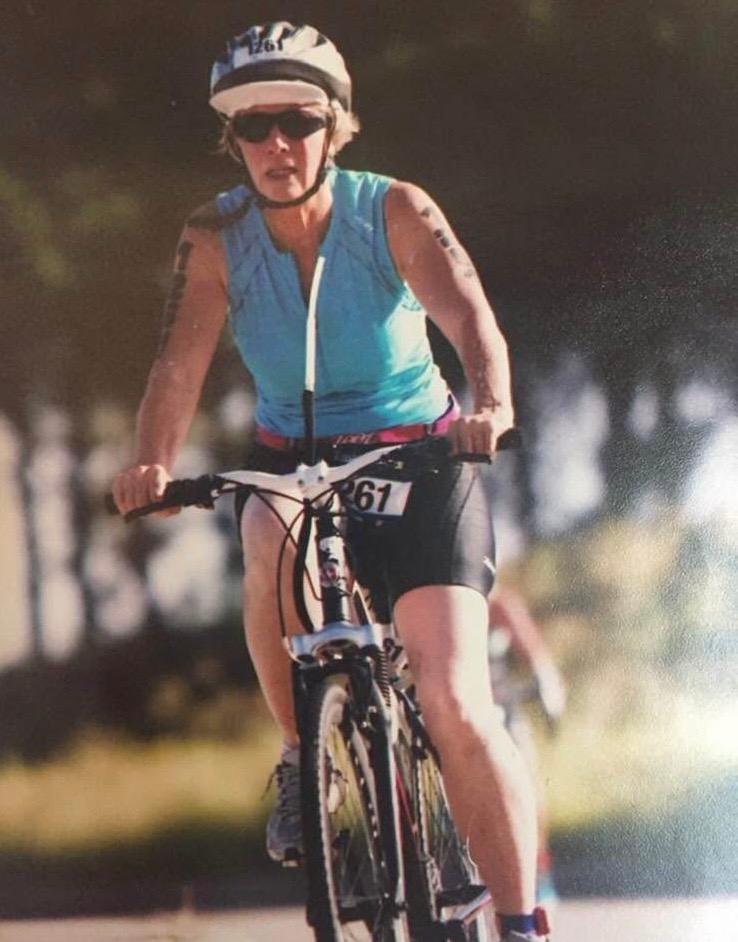
Susan began competing in triathlons when she turned 62. (Photo by Susana)
A year and a half after her stroke, Susana is back to living her normal life. She has full range of motion in her left side and is continuing her exercise regimen, lifting weights and training for running events.
“I attribute everything that I am, this normal life, to Torres’ decisions,” Susana said. “If he had delayed five minutes more or had hesitated, things would have been a lot different.”
Susana said her story highlights the importance of establishing healthy habits early in life, like eating a healthy diet and exercising regularly, both of which can reduce stroke risk.
“We only have this body, and we have to take good care of it and do the best we can with it, because you never know what may happen,” Susana said. “I think all that I did for so many years paid off big time.”
Torres said Susana’s story also emphasizes the importance of seeking providers who are specialized in stroke care.
“It’s not a death sentence,” Torres said of having a stroke. “We have a lot of interventions that we can do to patients. And the earlier you show up to a hospital, the more interventions we can do.”


