

At the Bedside: Houston teen makes astounding recovery after life-threatening soccer injury

Peter H. Yang, MD, performed multiple brain surgeries to heal a pseudoaneurysm that Camilo Mancera, 15, suffered after a soccer injury. (Photo by the Mancera family)
The last thing 15-year-old Camilo Mancera remembers from Jan. 14, 2025, is running for the soccer ball during practice with his Bellaire High School teammates.
Camilo, the team’s goalkeeper, says he remembers his teammate going for the ball at the same time that he slid for it, and feeling their knee make contact with his neck. For a brief moment, he stood up. But he was soon rushed to the emergency room after collapsing on the field.
Two weeks later, Camilo woke up in a hospital bed.
“I just had an image in my head of the soccer ball, and I didn’t know what happened or what it meant,” he said.
But Camilo couldn’t express that to his parents or doctors. He couldn’t speak, and he slowly realized that the left side of his body was completely paralyzed.
Camilo would later learn that the hit had caused what’s known as a carotid artery dissection, which occurs when the layers of one of the neck’s carotid arteries tear or break apart. That led to a pooling of blood in Camilo’s brain known as a pseudoaneurysm, named because it doesn’t involve all of the layers of the artery involved in a “true” aneurysm.
Despite what the name pseudoaneurysm would suggest, the condition is still life threatening.
Peter H. Yang, MD, assistant professor at McGovern Medical School at UTHealth Houston and a pediatric neurosurgeon at UT Physicians and Memorial Hermann-Texas Medical Center, said Camilo showed up to the hospital in dire straits. One of his pupils was larger than the other, and a CT scan confirmed the large amount of blood in Camilo’s brain, from the pseudoaneurysm rupturing.
He was rushed to the operating room, where Yang made a large incision about the size of his palm in the right side of Camilo’s head. The incision — which was in the shape of a question mark — and removal of a large portion of the skull allowed Camilo’s brain to swell without compressing other parts of the brain, which could have been fatal.
It was the first of six brain surgeries Yang and others would perform on Camilo during what would be a long road to recovery.
“While we more commonly see blunt head and neck trauma from sports-related injuries, it is very uncommon for a carotid artery dissection to happen from this mechanism,” Yang said. “In Camilo’s case, not only did he have a dissected artery, it was so severe that the artery quickly ballooned into a pseudoaneurysm and ruptured. If it had ruptured again, it would have been fatal.”
After the emergency surgery, an endovascular procedure overnight involved sacrificing the blood vessel supplying the pseudoaneurysm in the hope that blood vessels from the other side of his brain could supply enough blood to the injured side. Another surgery was later required to take out a clot that had formed on Camilo’s brain, and another to place a shunt in his brain to allow excess fluid to safely exit his head.

Camilo Mancera, 15, required six brain surgeries after suffering a soccer injury in January 2025. (Photo by the Mancera family)
It wasn’t until Camilo’s fifth surgery that Yang was able to replace Camilo’s skull through a procedure that’s known as a cranioplasty.
“Brain injury can be thought of in two parts. The first part occurs in the field, which consists of direct brain damage, causing bleeding and/or skull fracture. The second part occurs over the next few days to weeks, which consists of brain swelling and brain fluid imbalance, called hydrocephalus, that can add to the initial injury,” Yang said. “Camilo needed three emergency surgeries to treat the initial injury and two more surgeries in a delayed fashion to treat hydrocephalus and for the brain swelling to be reduced enough for the cranioplasty.”
Playing on the soccer team for his Houston high school was a dream Camilo had worked several years toward. Soccer ran in his family. His father, Juan Mancera, played soccer when he was in high school and into his early adulthood.
His family expected some injuries to occur during Camilo’s soccer career, as his father suffered a knee injury as a young adult that required surgery. But they never expected Camilo’s life to change so dramatically — or be threatened — as a result of the sport.
Over the next three months, in addition to multiple brain surgeries, Camilo underwent procedures that included an induced coma and placement on a feeding tube. From his hospital bed, he worked on learning how to speak again, celebrating every word and small victory.
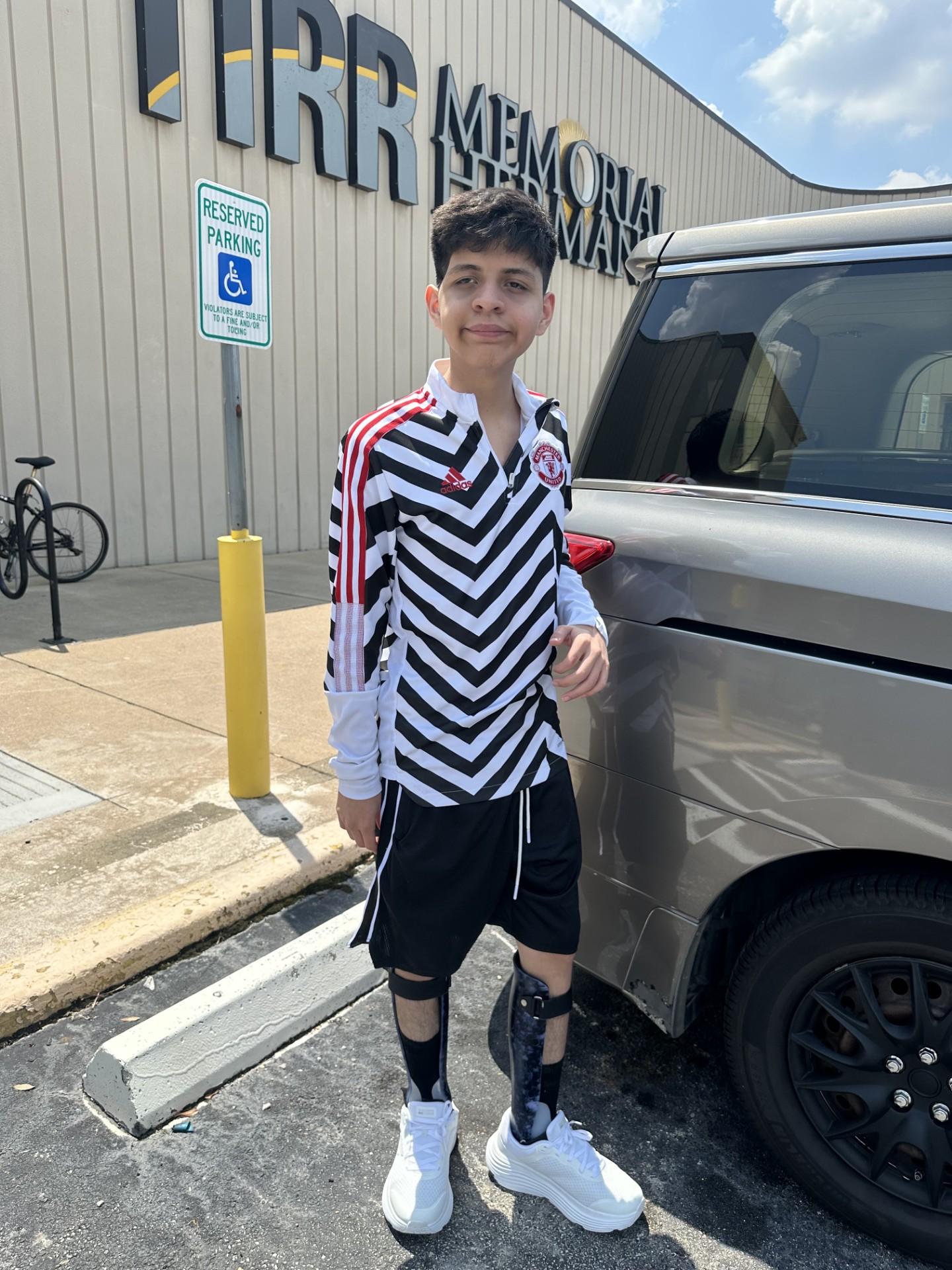
After a nearly three-month hospital stay, Camilo Mancera, 15, was transferred to TIRR Memorial Hermann for physical and occupational rehabilitation. (Photo by the Mancera family)
After a nearly three-month hospital stay, Camilo was transferred to TIRR Memorial Hermann for physical and occupational rehabilitation. He spent the next several weeks practicing how to walk and performing exercises to strengthen his arms and legs. It was grueling work, but by the summer, he had made enough progress to recover at home.
“Camilo was extremely courageous and never showed he was fearful at any point,” Yang said. “He’s always smiling. He’s very mature for someone his age.”
A year after his injury, Camilo has made a miraculous recovery. He is back in classes at Bellaire High School, and talking on his own. Doctors say he’ll likely be able to walk on his own again, too, but for now, he uses an ankle and knee brace to support his once-paralyzed left leg.
“To see God give Camilo the chance to live, it’s a miracle,” his mom, Judith Mancera, said in Spanish. “He gets better everyday. It’s a big miracle.”
While doctors say that it’s possible that Camilo could play soccer again, he’s not sure if he’ll ever be ready to return to the field. Camilo says it hurts him to know that his career was cut short, but he’s mostly grateful for a second chance at life.
“I feel really happy. I feel like I really show that nothing is really impossible,” Camilo said.


