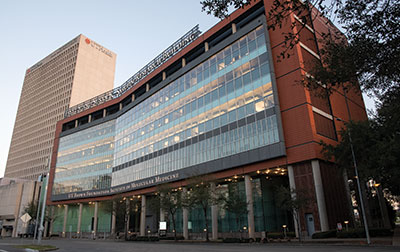


The Brown Foundation Institute of Molecular Medicine for the Prevention of Human Diseases

 Wenliang Li, Ph.D.

Wenliang Li, Ph.D.

Assistant Professor, Texas Therapeutics Institute

wenliang.li@uth.tmc.edu

713-500-3363

Dr. Wenliang Li’s research is to study novel molecular mechanisms of metastasis with the goal of identifying new drug targets for the development of better therapeutics for human cancers.

Cancer remains one of the most lethal and costly human diseases. Localized primary tumors rarely lead to death of cancer patients. It is metastasis, the spread of cancer to other parts of the body, that is responsible for over 90% of cancer mortality. However, metastasis is still poorly understood and the current approaches to prevent or treat human metastatic diseases are mostly unsuccessful. Through a unique combination of RNAi & cDNA screens, cancer genomics, molecular cell biology, mouse models and patient specimens, Dr. Wenliang Li’s lab is attacking the problem of metastasis in a novel way.

Dr. Li obtained his Ph.D. in Genetics from Case Western Reserve University in 2004. His dissertation work was conducted in Dr. Bryan Williams’ lab at Cleveland Clinic Foundation, where he constructed a cancer microarray and used it to identify gene expression patterns that were associated with genetics and prognostics of human Wilms tumors. He then joined Dr. Ed Harlow’s lab at Harvard Medical School for his postdoctoral training, where he provided critical contributions in a series of collaborative studies in identifying kinases controlling survival and proliferation of human cells. Later on, urged by the tremendous biomedical needs to study and target metastasis, Dr. Li initiated independent research to discover novel players for metastasis. In 2010, Dr. Li joined the Brown Foundation Institute of Molecular Medicine, where he will continue to study metastasis. He is also a member of the Texas Therapeutics Institute, a joint program of The University of Texas Health Science Center at Houston, The University of Texas M. D. Anderson Cancer Center and the Departments of Chemistry and Biochemistry at The University of Texas at Austin. 

Through genomics, RNAi and cDNA functional screens using cell culture and mouse models, Dr. Li has identified several human genes that play important but previously unknown roles in cancer metastasis (unpublished work). His lab is currently investigating the signaling pathways and molecular mechanisms of these interesting candidates using molecular, cell biology, biochemistry, genomics, proteomics and mouse models.

Another exciting research program in Dr. Li’s lab is involved in identifying and studying novel regulators of epithelial-mesenchymal transition (EMT) and stem cell phenotypes. EMT is a developmental program of biological cells characterized by repression of E-cadherin expression, loss of cell adhesion, and increased cell mobility. It is a central mechanism for diversifying the cells found in complex tissues. EMT confers cells with migratory and invasive properties, induces stem cell phenotypes, prevents apoptosis and senescence (see some recent reviews by others: Thiery JP, et al. Cell, November 2009; Kalluri R, Weinberg RA, J. Clin. Invest. June 2009). Increasing evidence indicates that EMT contributes to tissue repair, organ fibrosis, carcinoma progression, cancer resistance to chemotherapy and targeted therapy (see some recent reviews by others: Voulgari A, Pintzas A, Biochim Biophys Acta, December 2009; Sabbah M, et al. Drug Resist Update, Aug-Oct 2008).

Kinases play central roles in many aspects of signaling transduction, cell physiology and diseases. They are also one of the most important gene families for cancer drug development. Our literature search indicated that the majority of >700 kinases in human kinome are actually poorly studied. Dr. Li’s lab is employing unbiased functional screens against human kinome to identify kinases as novel regulators of EMT and linking them to stem cell phenotypes and metastasis. Investigation of the molecular mechanisms of these kinases will have a significant impact in expanding our knowledge in the crossroad of exciting and critical areas, such as development, stem cell, drug resistance and metastasis. These kinases may become biomarkers. For example, those primary tumors that over-express kinases promoting EMT may be more inclined to metastasize or relapse, and thus may be treated more intensively. These kinases may also become targets for novel drug development for metastatic diseases.

Awards:

1. Rising STARS Award, University of Texas System, 2010

2. AACR-Aflac Scholar-In-Training Award, 2009

3. Excellence in Graduate Research Award, Cleveland Clinic Foundation, 2004

Publications in Peer-reviewed Journals:

  • Baldwin A, Grueneberg DA, Hellner K, Sawyer J, Grace M, Li W, Harlow E, Münger K. V. Synthetic lethal interactions between p53 and the protein kinases SGK2 and PAK3. Proceedings of the National Academy of Sciences USA (PNAS). 2010 Jul 13;107(28):12463-8
  • Grueneberg DA*, Li W*, Davies JE and Harlow, E. IV. shRNA screens identify   kinase requirements in human cells: differential kinase requirements in cervical and renal human tumor cell lines. Proceedings of the National Academy of Sciences USA (PNAS). 2008 Oct 28;105(43):16490-5. *these authors contributed equally (co-first author)
  • Bommi-Reddy A, Almeciga I, Sawyer J, Geisen C, Li W, Harlow E, Kaelin WG Jr, Grueneberg DA. III. Altered Kinase Requirements in VHL-/- Renal Carcinoma Cells Detected in a Pilot Synthetic Lethal Screen. Proceedings of the National Academy of Sciences USA (PNAS). 2008 Oct 28;105(43):16484-9.
  •  Baldwin A, Li W, Grace M, Harlow E, Münger K and Grueneberg DA. II. Genetic Interaction Screens Identify Alterations in Kinase Requirements Following HPV16 E7 Expression in Cancer Cells. Proceedings of the National Academy of Sciences USA (PNAS). 2008 Oct 28;105(43):16478-83.
  • Grueneberg DA*, Degot S*, Pearlberg J*, Li W*, Davies JE*, Baldwin A*, Endege W, Doench J, Sawyer J, Hu Y, Boyce F, Xian J, Munger K, Harlow E. I. Comparing Kinase requirements across Various Cell types. Proceedings of the National Academy of Sciences USA (PNAS). 2008 Oct 28;105(43):16472-7. *these   authors contributed equally (co-first author)

Note: These 4 PNAS papers I-IV in 2008 were selected as Signaling Breakthroughs of 2008  (the most exciting advances in signaling transduction research in 2008) in the popular annual Editorial Guide of journal Science Signaling (formerly Science STKE), a Science family journal.        

    • Sengupta S, Kim KS, Berk MP, Escobar P, Li W, Lindner DJ, Williams BRG, Xu Y. Lysophosphatidic acid down regulates tissue inhibitor of metalloproteinases (TIMPs), which are negatively involved in LPA-induced cell invasion. Oncogene. 2007 May 3;26(20):2894-901.
    • Graham K, Li W, Williams B, Fraizer G. VEGF is differentially expressed in WT1- and  DDS-LNCaP cells. Gene Expression. 2006;13(1):1-14.
    • Pearlberg J, Degot S, Endege W, Park J, Davies J, Gelfand E, Sawyer J, Conery A, Doench J, Li W, Gonzalez L, Boyce FM, Brizuela L, Labaer J, Grueneberg D,  Harlow E. Screens using RNAi and cDNA expression as surrogates for genetics in mammalian tissue culture cells. Cold Spring Harb Symp Quant Biol. 2005;70:449- 59.
    • Li W, Kessler P, Yeger H, Alami J, Reeve AE, Heathcott R, Skeen J, Williams BRG. A gene expression signature for relapse in primary Wilms tumor. Cancer Research. 2005 Apr 1; 65(7):2592-601.
    • Li W, Kessler P, Williams BRG. Transcript profiling of Wilms tumors reveals systematic connections to kidney morphogenesis and a gene expression pattern associated with unfavorable histology. Oncogene. 2005 Jan 13; 24(3):457-68.
    • Stanhope-Baker P, Kessler P, Li W, Williams BRG. The WT1 target gene Podocalyxin is transcriptionally repressed by p53. J Biol Chem. 2004 Aug 6;279(32):33575-85.

    Contact Information:

    Wenliang Li, Ph.D.
    Assistant Professor
    The Brown Foundation Institute of Molecular Medicine
    The University of Texas Health Science Center at Houston
    Texas Therapeutics Institute, SRB 537C
    1825 Pressler Street
    Houston, TX 77030
    Email: wenliang.li@uth.tmc.edu